Teamwear Fabrics Explained: How to Pick the Right Sportswear Material
For most football kits, use lightweight polyester between 130 and 170 GSM. It is light, dries fast, holds sublimation prints well, and lasts through many washes.
Other sports and jobs need other fabrics. Here is the quick version:
- Hot weather: birdseye, mesh, micro polyester, or performance polyester.
- Rugby: heavier polyester or pique, around 180 to 220+ GSM.
- Stretch and fitted wear: polyester-spandex or nylon-spandex.
- Cold weather: fleece, French terry, or tricot in layers.
- Casual club wear and fan shirts: cotton or cotton/polyester blends.
The best fabric depends on the sport, the weather, the garment, the print method, and the budget. Pick the fabric first. Then design the kit around it.
What Is GSM, and Why Does It Matter?
GSM means grams per square metre. It tells you how heavy a fabric is. Cut a piece of fabric one metre wide and one metre long. Weigh it. That weight is the GSM.
A higher number means a heavier fabric. A lower number means a lighter one.
Common GSM Ranges
| GSM | Weight Level | Typical Use |
|---|---|---|
| 120 | Very light | Hot-weather jerseys, mesh panels |
| 140 | Light | Football and training shirts |
| 160 | Light to medium | Standard team jerseys |
| 180 | Medium | Premium jerseys, polos |
| 220 | Heavier | Rugby wear, light sweatshirts |
| 300+ | Heavy | Hoodies, winter garments |
Higher GSM Is Not Always Better
Many buyers think a heavy fabric means a better shirt. That is wrong.
Picture two football shirts. One is 140 GSM performance polyester. The other is 200 GSM. A player running for 90 minutes will feel better in the 140 GSM shirt. It is lighter. It lets more heat out. It does not weigh him down when he sweats.
GSM tells you weight. It does not tell you quality. Two fabrics with the same GSM can feel and perform very differently. The fibre, the knit pattern, and the finish all matter.
Rule to remember: match the GSM to the sport, the season, and the garment.
Quick Comparison of 15 Teamwear Fabrics
Use this table as a map. Details for each fabric come next.
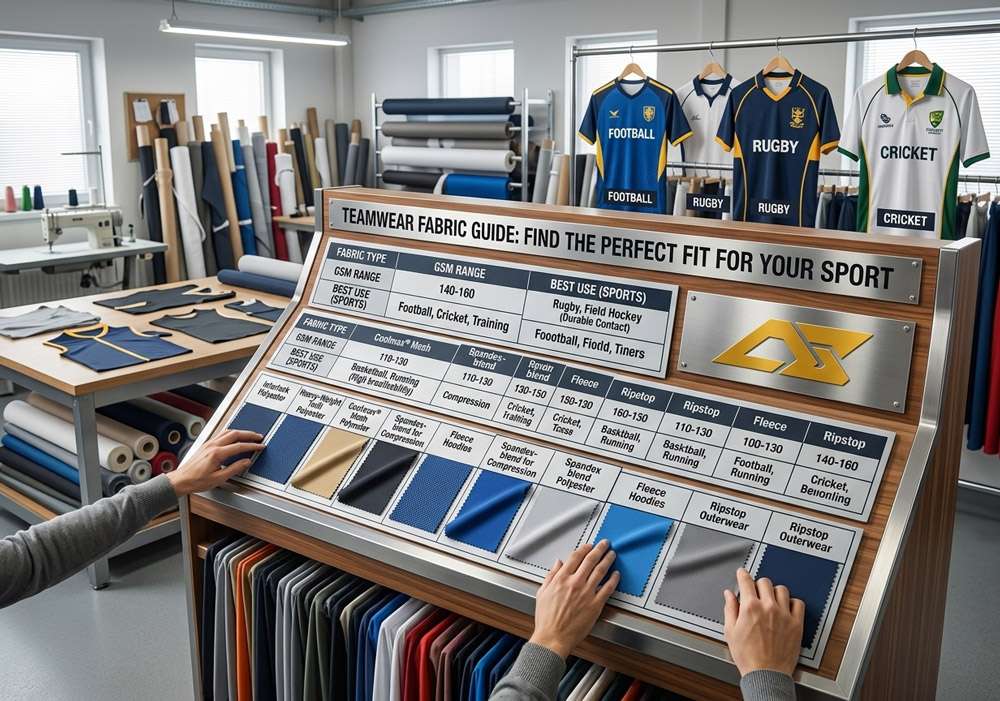
| Fabric | Typical GSM | Main Strength | Best For |
|---|---|---|---|
| Interlock polyester | 130–170 | Smooth, great for prints | Football jerseys |
| Birdseye polyester | 130–160 | Airflow | Hot-weather football, running |
| Honeycomb/pique polyester | 140–180 | Texture, durability | Jerseys, polos |
| Mesh polyester | 110–150 | Maximum ventilation | Panels, basketball, training |
| Micro polyester | 120–160 | Soft and light | Training tops, jerseys |
| Dry-fit / performance polyester | 130–170 | Moves sweat away | Active sports, gym |
| Jacquard polyester | 140–180 | Built-in patterns | Premium kits |
| Polyester-spandex | 160–220 | Stretch | Compression, base layers |
| Polyester fleece | 240–320 | Warmth | Hoodies, winter wear |
| French terry | 220–300 | Comfort inside | Sweatshirts, tracksuits |
| Polyester tricot | 180–250 | Smooth and tough | Tracksuits, jackets |
| Nylon-spandex | 160–220 | Stretch and recovery | Fitted performance wear |
| Cotton/polyester blend | 160–220 | Soft and easy care | Team T-shirts, polos |
| 100% cotton | 160–220 | Natural feel | Fan wear, casual shirts |
| Recycled polyester | 130–180 | Recycled content | Eco-minded product lines |

Match-Day Fabrics: Light, Cool, and Fast-Drying
These fabrics are the core of football, soccer, futsal, and running kits. All are polyester. Polyester does not soak up water as cotton does. It lets sweat spread out and dry fast.
1. Interlock Polyester (130–170 GSM)
Interlock is a smooth, double-knit fabric. Both sides feel even. That smooth surface makes it a top pick for sublimation printing.
Main features:
- Smooth surface
- Lightweight
- Strong and durable
- Dries quickly
- Easy to wash and care for
Best for: football jerseys, soccer kits, training shirts, academy teamwear, and general sports uniforms.
Example: A youth club orders 25 matching shirts with a full-colour pattern across the chest. Interlock at 140–160 GSM is a safe pick. The print stays sharp. The shirt stays light.
For standard football teamwear, 140–160 GSM interlock is a practical starting point.
2. Birdseye Polyester (130–160 GSM)
Birdseye has a tiny, dotted texture. The small holes and bumps help air move through the cloth. Players who run a lot make plenty of heat. Birdseye helps them stay cooler.
Best for: football, soccer, running, training shirts, and team jerseys.
Example: A team in a hot city plays at 4 p.m. in summer. Birdseye is a smart choice. It is light and airy, so players feel less trapped in their shirts.
3. Micro Polyester (120–160 GSM)
Micro polyester uses very fine fibres. That gives it a soft, smooth feel. It looks clean and takes prints well.
Benefits:
- Lightweight
- Soft on the skin
- Dries fast
- Easy to care for
- Good for printing
Use it for football shirts, training tops, and other performance clothing.
4. Mesh Polyester (110–150 GSM)
Mesh is built for airflow. It has open or half-open holes. Air passes right through the fabric. It is the coolest option on this list.
Common uses:
- Football training shirts
- Side panels
- Underarm panels
- Basketball jerseys
- Running wear
Mesh does not have to cover the whole shirt. Makers often combine it with another polyester fabric. The body stays solid, and the sides or underarms get mesh panels. Heat leaves exactly where players sweat most.
5. Dry-Fit / Performance Polyester (130–170 GSM)
Performance polyester is made to pull moisture away from the skin. It is a top choice when players work hard for a long time.
Features:
- Moves sweat away from the body
- Dries quickly
- Light
- Breathable
- Durable
Best for: football, soccer, basketball, running, training, and gym wear.
A word of warning: “Dry-fit” is not one exact fabric. Different suppliers use the name for different constructions. Always ask for the real fibre content and GSM. Do not trust the label alone.
Textured and Premium Fabrics
Some teams want a kit that looks special up close. Texture can do that.
6. Honeycomb / Pique Polyester (140–180 GSM)
These fabrics have a raised pattern on the surface. Honeycomb looks like tiny hexagons. Pique has a small woven-looking bump.
Advantages:
- Good durability
- Textured look
- Breathable structure
- Premium appearance
- Feels different from flat polyester
Common uses: football jerseys, polo shirts, training tops, club apparel, and uniforms.
Textured fabrics also hold their shape well. That is why they show up in polos and rugby-style shirts.
7. Jacquard Polyester (140–180 GSM)
Jacquard fabric has its pattern built into the cloth. The design is woven or knitted in. It is not just printed on top.
That makes a shirt look richer than a basic flat fabric. Think of subtle stripes, diamonds, or a faint club crest pattern that you can see only when the light hits it.
Best for: premium football jerseys, pro-level teamwear, club shirts, and training tops.
Tip: Jacquard works best when a brand wants a quiet, classy pattern. If you want a loud, colourful design, sublimation on a smooth fabric may fit better.
Stretch Fabrics: Fitted and Flexible
8. Polyester-Spandex (160–220 GSM)
This blend mixes polyester with spandex, a stretchy fibre. The fabric stretches and snaps back. It hugs the body without feeling stiff.
Best for: compression wear, performance shirts, training tights, base layers, and fitted sportswear.
The amount of spandex changes from fabric to fabric. A shirt with a little spandex gives light stretch. A shirt with a lot gives a tight, compressive fit. Tell your maker how much stretch you need.
12. Nylon-Spandex (160–220 GSM)
Nylon is another strong synthetic fibre. Mixed with spandex, it gives great stretch, quick recovery, and toughness.
Best for: compression garments, performance wear, training clothes, fitted sportswear, and base layers.
Polyester-spandex vs nylon-spandex: Both stretch well. Both work for fitted wear. One thing to know for printing: sublimation is designed for polyester. If you want a fully sublimated design on a stretch garment, polyester-spandex is usually the safer match.
Warm-Weather Layers and Cold-Weather Fabrics
Football jerseys should stay light. Warmth should come from extra layers, not from one thick shirt. These fabrics are for those extra layers.
9. Polyester Fleece (240–320 GSM)
Fleece is soft, fluffy, and warm. It is much heavier than jersey fabric.
Best for: hoodies, sweatshirts, warm-up clothing, winter teamwear, and travel wear.
Fleece is great before and after a match. It is usually too heavy for the match shirt itself.
10. French Terry (220–300 GSM)
French terry is smooth on the outside. The inside has small loops of yarn. That looped side feels soft and helps the garment feel comfortable.
Best for: sweatshirts, hoodies, tracksuits, training wear, and lifestyle teamwear.
It is a nice balance of comfort and toughness. It is also lighter than most fleece, so it works in cool weather more than in freezing weather.
11. Polyester Tricot (180–250 GSM)
Tricot is a smooth, tightly knit fabric. You see it on many tracksuits. The outside looks sleek. It handles regular team use well.
Best for: tracksuits, training jackets, warm-up suits, and team travel clothing.
Warmth Quick Guide
| Fabric | Warmth | Feel | Weight |
|---|---|---|---|
| Fleece | Highest | Soft, fluffy | Heavy |
| French terry | Medium | Soft inside, smooth outside | Medium–heavy |
| Tricot | Light–medium | Smooth, sleek | Medium |
Casual and Natural Fabrics
13. Cotton/Polyester Blends (160–220 GSM)
These mix cotton’s soft feel with polyester’s strength and easy care. They are comfy. They last longer than plain cotton. They dry faster too.
Advantages:
- Comfortable
- Durable
- Versatile
- Good for casual teamwear
Best for: team T-shirts, club merchandise, polo shirts, casual sportswear, and travel clothing.
For hard football matches, a real performance polyester is usually better than a high-cotton fabric.
14. 100% Cotton (160–220 GSM)
Cotton feels natural and soft. It breathes well in casual use. It is popular for fan shirts and club T-shirts.
Limits for sports: Cotton soaks up sweat. When it gets wet, it turns heavy and slow to dry. That makes it a weak choice for high-effort match jerseys.
Example: A club sells shirts to fans at the stadium. Cotton is a great pick. Fans wear them to sit and cheer, not to sprint.
The Eco Option
15. Recycled Polyester (130–180 GSM)
Recycled polyester is made from recycled polyester sources. Many types come from used plastic bottles. It performs much like regular polyester. It works for sportswear and can support clubs that want more recycled content.
Possible benefits:
- Recycled fibre content
- Performance close to regular polyester
- Suitable for sportswear
- Helps eco-focused product lines
Be careful with claims. A “sustainable” label means little without proof. Ask what the fibre source is. Ask for documents that back it up. If a maker cannot show them, do not print eco claims on your product.
Which Fabric Is Best for Football Jerseys?
No single fabric wins for every team. But you can sort most needs into three levels.
Lightweight Jersey: 120–140 GSM
Best for:
- Hot climates
- Summer football
- Hard training sessions
- Very light performance
Standard Jersey: 140–160 GSM
Best for:
- Club football
- Academy kits
- Regular teamwear
- Sublimated jerseys
Heavier Premium Jersey: 160–180 GSM
Best for:
- Premium teamwear
- Cooler weather
- More structured shirts
- Special designs
Across all three levels, 130–170 GSM polyester covers a broad, practical range for football.
Football Fabric vs Rugby Fabric
The two sports ask very different things from a shirt.
Football players run a lot. They need a shirt that is light and airy.
Rugby players tackle, grab, and get grabbed. They need a shirt that is tougher and can handle pulling and rubbing.
| Feature | Football | Rugby |
|---|---|---|
| Main need | Light and breathable | Strong and durable |
| Typical GSM | About 130–170 | About 180–220+ |
| Common fabrics | Interlock, birdseye, performance polyester | Heavy polyester, pique, performance fabrics |
| Feel | Airy, smooth | Sturdy, structured |
These numbers are development guides, not strict rules. The final choice should match the garment design and what the customer needs.
Which Fabric Is Best for Hot Weather?
Go light. Go breathable. Choose fabrics that let air in and sweat out.
Good picks:
- Birdseye polyester
- Mesh polyester
- Lightweight interlock
- Micro polyester
- Performance polyester
Hot places such as Australia, parts of the USA, the Middle East, and Southern Europe make airflow and sweat control extra important.
Tip: Use mesh panels on the sides and under the arms. They cool the body without making the whole shirt see-through.
Which Fabric Is Best for Cold Weather?
Do not solve cold with one heavy jersey. Use layers instead.
A simple layering plan:
Base layer → Jersey → Training jacket → Tracksuit or warm-up layer
Each layer does one job. Players can add or remove pieces as the weather changes. This is more flexible than a thick shirt they cannot take off.
Fabrics to use in the outer layers:
- Polyester fleece
- French terry
- Polyester tricot
- Heavier performance fabrics
Sublimation and Teamwear Fabric
Sublimation is a popular way to decorate custom kits. Special dye is turned into a gas by heat and pressed into the fabric. The colour becomes part of the fibres. It does not sit on top like a sticker.
This only works well on polyester. That is why fabric choice matters so much.
Simple rule: Polyester is the preferred fabric for sublimation.
Polyester gives you bright colours and sharp detail. Cotton does not hold the dye the same way. A cotton shirt will look faded or dull with the same process.
Check These Before Production
Before a factory starts your order, confirm:
- Fabric composition
- GSM
- Fabric width
- Sublimation suitability
- Colour performance
- Shrinkage
- Wash performance
Note on colour: Sublimation works best on white or light-coloured polyester. Dark fabric can change how the printed colours look. Ask for a sample.
How Fabric Texture Changes Teamwear
Texture is more than looks. It changes how a shirt feels and works.
Texture can affect:
- Hand feel
- Breathability
- Airflow
- Moisture control
- Appearance
- How the print looks
- Player comfort
Examples:
- Mesh boosts ventilation.
- Smooth interlock gives a clean base for sublimation.
- Jacquard and textured fabrics create a premium look without needing lots of printed graphics.
Fabric Selection by Sport
| Sport | Recommended Fabric Types | Main Consideration |
|---|---|---|
| Football / Soccer | Interlock, birdseye, performance polyester | Light and breathable |
| Basketball | Mesh, interlock, performance polyester | Ventilation and free movement |
| Rugby | Heavy polyester, pique, performance fabrics | Strength and durability |
| Running | Lightweight performance polyester, mesh | Breathability |
| Futsal | Interlock, performance polyester | Light and flexible |
| Cricket | Polyester, pique, performance fabrics | Comfort and durability |
| Training | Interlock, mesh, performance polyester | Moisture management |
| Tracksuits | Tricot, fleece, French terry | Warmth and durability |
| Hoodies | Fleece, French terry | Warmth and comfort |
| Polo shirts | Piqué, honeycomb, cotton/polyester | Structure and comfort |
8 Questions to Ask Before You Choose a Fabric
Go through these questions in order. They will narrow your choices fast.
1. What sport is it for?
Football, rugby, basketball, and running all ask for different things.
2. Where will it be used?
Indoor courts, natural grass, and artificial turf can change what works best.
3. What is the climate?
Hot weather calls for light, breathable fabric. Cold weather calls for layers.
4. What GSM do you need?
Pick the GSM that suits the garment. Do not pick a high number just because it sounds better.
5. Do you need sublimation?
If yes, the fabric must be polyester or a polyester-rich blend.
6. Does the garment need stretch?
Compression and fitted pieces may need polyester-spandex or nylon-spandex.
7. Is it matchwear or training wear?
Match jerseys usually put lightweight first. Training and travel pieces can use other fabrics.
8. What is your budget?
Fabric choice changes the final cost of the garment. Set a target price early.
Common Mistakes to Avoid
Choosing by GSM alone. Weight is only one part of the picture. Knit type and fibre matter too.
Using cotton for hard match play. It gets heavy with sweat.
Picking fabric after the design. The fabric limits what you can print and how it will look. Choose it first.
Trusting names on labels. Terms like “dry-fit” or “performance” can mean different things. Ask for the composition.
Skipping samples. A photo cannot show how a fabric feels or stretches. Ask for a swatch.
Making green claims without proof. Only say “recycled” if you can back it up.
The Arbish Sports Teamwear Fabric Range
Arbish Sports can work with many fabric types for custom teamwear. Options can include:
- Interlock polyester
- Birdseye polyester
- Honeycomb/pique
- Mesh
- Micro polyester
- Performance polyester
- Jacquard polyester
- Polyester-spandex
- Polyester fleece
- French terry
- Polyester tricot
- Nylon-spandex
- Cotton/polyester blends
- 100% cotton
- Recycled polyester
You can share your preferred fabric composition, GSM, colour, texture, garment style, and intended use. For custom football kits, 130–170 GSM polyester is a practical place to start. For rugby, tracksuits, hoodies, and cold-weather pieces, heavier fabrics make more sense.
A good teamwear maker should also send fabric samples. They should explain the construction and GSM in plain words. And they should suggest a material that fits your sport and needs.
Teamwear Fabrics at a Glance
Pick by sport, weather, and print method.
What is GSM?
Grams per square metre. A bigger number means heavier cloth.
Heavier is not better. Match the GSM to the sport.
15 fabrics, sorted by weight
Match-day
Textured
Stretch
Warm
Casual and eco
Football vs rugby
Football
130–170 GSM Light and airy- Interlock
- Birdseye
- Performance polyester
Rugby
180–220+ GSM Strong and tough- Heavy polyester
- Pique
- Performance fabrics
Hot weather or cold?
Hot: go light
- Birdseye
- Mesh
- Lightweight interlock
- Micro polyester
- Performance polyester
Cold: add layers
Printing with sublimation?
Best fabric by sport
Ask these 8 questions first
Choose the fabric first. Then build the kit.
Ask for samples before you order.
Arbish Sports: custom teamwear and sportswearFinal Guide: Match the Fabric to the Job
There is no best sportswear fabric for everyone. The right choice comes from putting these together:
Sport + climate + garment type + GSM + fabric composition + performance needs + print method + budget
Here is how that plays out:
- Pro football kit: lightweight polyester.
- Rugby jersey: heavier, stronger fabric.
- Training shirt: breathable mesh or performance polyester.
- Winter tracksuit: polyester tricot or fleece.
- Fan T-shirt: cotton or a cotton/polyester blend.
Choose the fabric before you finalize the design. Treat it as the base of the kit, not a last step.
Frequently Asked Questions
What GSM is best for football jerseys?
About 130–170 GSM polyester works for most teams. The exact pick depends on the weather, the design, and how you want the shirt to perform.
Is higher GSM better?
No. Higher GSM only means heavier fabric. For fast, high-effort sports like football, a lighter fabric is often the better option.
Which fabric is best for sublimation football kits?
Polyester. It holds sublimation dye well and gives bright, sharp colours.
What fabric is best for hot-weather football?
Light, breathable polyester. Birdseye, mesh, micro polyester, and performance polyester are all good picks.
What fabric is best for tracksuits?
Polyester tricot, fleece, and French terry are common. Choose based on how warm you need the tracksuit to be and what style you want.
Can football kits be made with custom fabric?
Yes. Fabric composition, GSM, texture, and construction can be chosen to fit your product spec and the options your maker can produce.
What is the difference between football and rugby jersey fabric?
Football shirts are usually light and airy. Rugby shirts are usually heavier and tougher because the sport is more physical.
Is cotton good for sports jerseys?
Cotton is fine for casual and fan wear. It soaks up sweat and gets heavy, so it is a poor choice for hard match play.
Is recycled polyester as good as regular polyester?
It performs in a similar way for sportswear. Ask your maker for proof of the fibre source if you plan to market it as recycled.
Ready to Choose Your Fabric?
Now you know how to match the fabric to the sport. The next step is to see real products.
Visit the Arbish Sports product category pages to browse football kits, training wear, tracksuits, hoodies, basketball uniforms, and custom sportswear. Pick your sport, choose your fabric and GSM, and ask for samples before you order.
Choose the right fabric first. Then build the right teamwear around it.
👉 For more information before deciding about your choice of fabric for your next teamwear order, contact our expert team now!